By Craig Booth
Estimated Read Time: 5 minutes
Why we’re sharing this: Science shouldn’t stay locked in journals. From time to time, we highlight one interesting research paper and bring it directly to you: clear, relevant, and ready to spark ideas for your own backyard and community projects.
(Based on Lin et al., Journal of Experimental Botany, 2023 — full reference below)
Find action steps at the end of this post!
When Water Runs Short
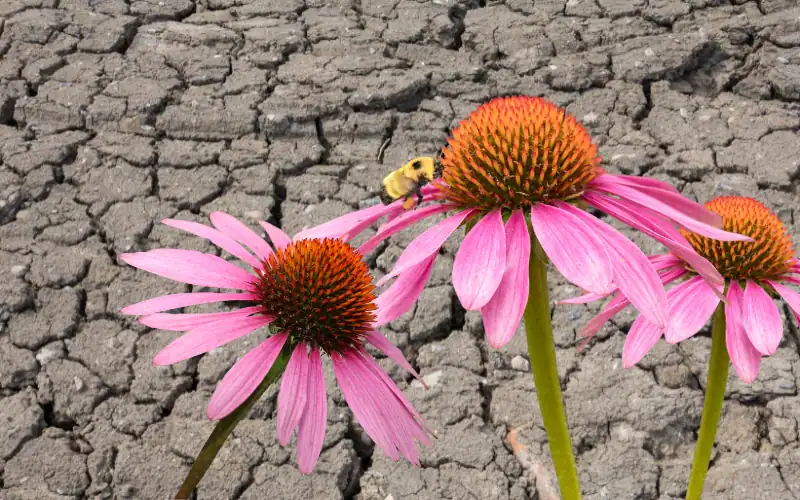
Imagine a hot sunny afternoon. Your feet kick up dust as you walk, the flowers are withering, and the grass is brittle underfoot. It's all thirsty. Your plants are clearly thirsty. However, what about the insects that pay them a visit? Do they thrive or do they also suffer?
Scientists have been asking this question for decades. A recent review pulled together what we know about how water (either too much or too little) changes the way plants and insects interact.
The short answer: water is a master switch — but how it flips can surprise you.
Keep reading and you’ll see how these tiny dramas play out in your own yard, and what small choices can help tip the balance toward resilience.
Sometimes drought makes plants tougher, sometimes weaker. The outcome depends on how severe the stress is, which plant species you’re looking at, which insect is feeding, and even what other stresses (like heat or poor soil) are happening at the same time. In other words, there are a lot more moving parts than you might think.
So how do plants actually cope when water disappears? As it turns out, they have a whole playbook of tricks.
How Plants Respond to Drought
When under stress, plants don't just sit quietly. They react in ways that are both clever and complicated, and each of their reactions change their relationships with insects. Plants have a playbook full of survival moves: chemical, seasonal, even social.
First, they can alter their chemistry.
Plants make special compounds that taste bitter or clog up insect digestion. In a mild drought, they often make more of these compounds, becoming tougher targets. But if the drought drags on, they slow down and produce less. It’s a gamble like pulling an all-nighter before a test. One late night might sharpen you up. Too many in a row, and you burn out. Plants, too, can sharpen their defenses under short stress but collapse under long stress.
In addition to this, drought can even accelerate the calendar.
Some plants bloom and set seed earlier than usual when water runs short. That way, they finish reproduction before the worst heat and dryness; and sometimes before insect numbers peak. It’s a survival shortcut, even if it means fewer flowers overall.
And perhaps most surprisingly, plants also speak through scent.
They release invisible perfumes that can repel pests or call in allies like native ladybugs and parasitic wasps that hunt or parasitize the leaf-chewers and sap-suckers threatening them. A small drought can turn the volume up on those scents. But a deep drought can silence them completely, leaving plants without their backup team.
Each of these gambles—chemical, seasonal, and social—shifts the rules for the insects around them.
Winners, Losers, and Timing Traps
When rain runs short, the dinner table shifts, but not everyone goes hungry.
Some sap-feeders—especially certain aphids—can do well under mild drought, with studies showing improved insect performance in specific cases. At the same time, leaf-eaters fare less well. Drought often ramps up plants’ physical armor. For these leaf-munchers, a drought-stricken leaf is more like chewing old leather than fresh salad.
Even timing becomes a gamble. When drought pushes plants to bloom early, pollinators may wake up to find the buffet already closed. A few lost weeks between flower and bee might not sound like much, but it can mean fewer seeds, fewer caterpillars, and fewer birds come nesting season.
And these shifts don’t stop with insects: Hungry caterpillars mean less food for birds; fewer pollinators mean less fruit for mammals and people alike. A short dry spell can ripple outward—from your yard, through meadows, and forests—reshaping who eats, who thrives, and who simply holds on.
When water runs short, the garden’s food web reshuffles; some species thrive, others struggle, and their relationships change in surprising ways. This visualization should show how drought alters who eats, who pollinates, and who depends on whom.
Water, it turns out, doesn’t just quench thirst. It quietly decides the winners and losers of the entire food web.
Water, Climate, and What You Can Do
As our climate changes, drought events are becoming more common, altering the balance between plants and insects. In no small part, it is water that quietly decides who wins, who loses, and how resilient an ecosystem will be.
The hopeful part: the same steps that help your yard hold water – things that are likely extremely familiar to HNP readers – also make it more resilient.
- Plant a variety of native plants. A diverse mix means some will thrive even in tough conditions.
- Shrink your lawn. Lawns gulp water but provide little food or shelter for wildlife.
- Where planting is sparse, mulch your soil. Healthy soil acts like a sponge, holding water and buffering plants through dry spells.
- Layer your plantings. Trees, shrubs, and flowers together create shade and cooler microclimates that protect pollinators and reduce evaporation.
- Start small. Every native plant you add strengthens the local web of life.
It may feel small to plant one plant, or remove a square foot of lawn, but together changes like this add up to shade, moisture, and life.
Closing Thought
Like us when we fight through too many sleepless nights, thirsty plants gamble, sometimes strengthening their defenses, sometimes burning out. The plants are not the only ones impacted by those bets. They influence the health of entire ecosystems by reverberating through pollinators, insects, and predators.
The tough part is that there is never just one pattern. Which plants and insects are affected, how severe the drought is, how long it lasts, and what additional pressures are at work all affect the result. Every forest and garden has its own set of regulations.
Water may be the master switch, but how it flips looks different everywhere.
So the next time you see a wilting flower, remember: even small acts of care: planting natives, building healthy soil, or saving water can ripple outward in powerful ways.
Together, we can help nature stay strong, even under the scorching summer sun.
Further Reading
This summary is based on: Lin, P.A., Kansman, J., Chuang, W.P., Robert, C., Erb, M., & Felton, G.W. (2023). Water availability and plant–herbivore interactions. Journal of Experimental Botany, 74(9), 2811–2828. https://doi.org/10.1093/jxb/erac481
 Craig Booth, PhD, is a technologist, educator, and lifelong nature enthusiast who believes that big change in the natural world starts with inspiring love for it. Trained as an astrophysicist, he now serves as Chief Technology Officer at an education company, where he works on tools that help people learn and connect through curiosity.
Craig is passionate about breaking down the walls that keep science locked away. He believes knowledge should belong to everyone, and that sharing the wonder of how the world works is one of the surest ways to help people care for it. His writing lives at the meeting point of science and nature, exploring how understanding deepens love and love deepens stewardship.