

News

Biodiversity Day – 22 May
In case you haven’t heard, life on earth is in trouble. This is why I am asking you to get on the Homegrown National Park® MAP. Each and every one of us has the power to regenerate biodiversity and we don’t have the luxury of time to do it.

10 Things to Get You Started
10 Things to Get You Started By Doug Tallamy / Revised 9.22.2021 Download Print Version Small Efforts by Many People: 71% of the lower 48 states is privately owned. East of the Mississippi river, over 85% of all land is privately owned. If we planted native on 50% of this private land we would restore […]

Not In Our Yard
GARDENING FOR LIFE Chances are, you have never thought of your garden – – indeed, of all of the space on your property – – as a wildlife preserve that represents the last opportunity we have for sustaining plants and animals that were once common throughout the U.S. But that is exactly the role that […]
Sharing a downloadable brochure about the biodiversity crisis / December 15, 2021
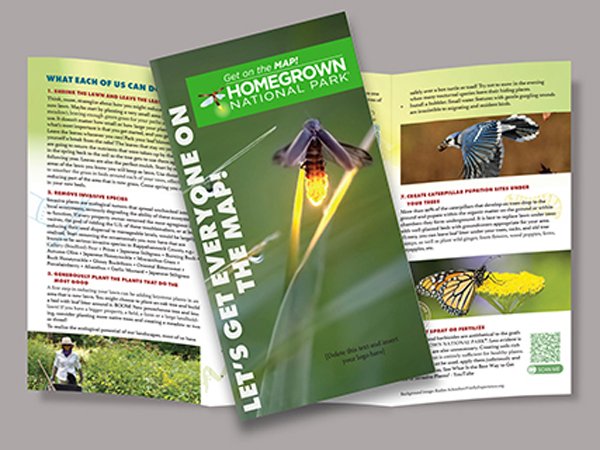
Thanks to RLEP’s [Rappahannock League for Environmental Protection] efforts we can offer everyone the share-worthy, downloadable & customizable brochure about the biodiversity crisis, HNP and what each of us can do to “get started” and get ON THE MAP!
Lovejoy and Wilson have spoken; now it\’s time to act / December 30, 2021
Tom Lovejoy introduced the term biodiversity in 1980 and E. O. Wilson patiently yet persistently worked thereafter to convince us that we cannot live without it. HNP’s grassroots initiative is the call-to-action that will regenerate biodiversity. The time is NOW to plant native and GET ON THE HNP MAP!
RLEP Lights Us Up!
Thank you Rappahannock League for Environmental Protection! RLEP’s efforts generously empower us to offer everyone the share-worthy, downloadable & customizable brochure about the biodiversity crisis, HNP and what each of us can do to “get started” and get ON THE MAP!
Plant it native – plant it forward: Spread the Word! / September 22, 2021
We are thrilled that we have so many entries on the Homegrown National Park® MAP representing acres and acres of land planted native!!
Big THANK YOU to all you early-adopters for taking the initiative to GET ON THE MAP!, for being ‘influencers’, for supporting the HNP call-to-action, for expressing your enthusiasm and encouraging others to get on the MAP. YOU cannot know how much your action and comments mean to Doug and me. We THANK YOU so much! HELP US SPREAD THE WORD!
Helping Nature Take Its Course / September 21, 2021
Helping Nature Take Its Course
The natural world we encounter today is not the same world we would have encountered 500 years ago, 100 years ago, or even 20 years ago.
When I was a boy (60 yrs ago), I could count on finding a box turtle, a spotted turtle, and several species of salamanders any summer day on a walk through a nearby woodlot. I would have kicked up scores of grasshoppers in the meadow I crossed before I reached that woodlot, and I never worried about picking up a deer tick because I didn’t know what a deer tick was; I had explored those fields and woods for years without ever encountering one. If I saw a white-tailed deer, it would have been a very special day, for they were rare in north central New Jersey where I grew up. I didn’t know much about plants, but nearly all of the species I walked by in those days were native to North Jersey.