


By Dee Salomon
Originally published in The Ungardener
Est. Read Time: 5 minutes
Cover photo by Lauren Lyons | Flag Pond, TN
Love it or hate it, there is no denying the several blankets of snow this winter were beautiful, especially as they visually muffled some of the damage they caused in the first place. There appears to be tree damage — some minor and some major — in many places, and now that we can move around, the pre-spring cleanup begins. Here, a heavy snow buildup on our sun porch roof crashed onto the shrubs below, snapping off branches and cleaving a boxwood in half, flattening it. The other area that has been flattened by the snow is the meadow, now heading into its fourth year of post-lawn alterations. A short recap on its genesis: I simply stopped mowing a half-acre of lawn, planted some flowering plants, spread little bluestem seeds and, far less simply, obsessively pluck out invasive plants such as sheep sorrel and stilt grass. And while it’s not exactly enchanting, it is flourishing, so much so that I cannot bring myself to mow.
I have doubts: If I mow in the spring, would I kill all the overwintering insects? If I mow after the first frost, as suggested in a 2017 paper by the esteemed Kim Stoner, Ph.D., on the Connecticut Agricultural Experiment Station website, would I lose the seed heads of yarrow, rattlesnake master and black-eyed Susan that birds are supposed to feed on in the winter? Paralyzed by indecision, I have not been able to bring myself to do even a partial cut.
I took a poll at a recent party attended by horticulturalists, environmentalists and garden experts. There was a consensus that early spring is indeed the best time to mow — early, before the ground-nesting birds like woodcock start nesting. I then called Mike Nadeau, whom I consider a meadow master of the Northwest Corner, and he concurred, following the Xerces Society meadow-mowing guidelines: mow in early spring when dandelions are in bloom.
Additionally, Nadeau suggests that mown paths should be rerouted at least every two years to prevent rhizomatous grasses from establishing, which can grow into meadow edges and look unsightly. And the window is short:
“It’s too late to mow when spring birds arrive in earnest and new meadow growth is taller than 6 inches.”
Xerces Society says this is the time most insects have hatched out of hollow stems and is between bird migrations.”
Nadeau’s experience has borne this out.
“I stress not to mow in fall because a dormant meadow is a haven for winter critters of all ilk. Birds use dormant plants for nesting materials, seeds to eat and refuge — not to mention the other mammalian life that benefits from a meadow. An argument that has worked for me to discourage fall mowing is to describe a dormant meadow, with its myriad seed heads and foliage, as kinetic sculpture, especially with snowfall. It’s a beauty all its own.”
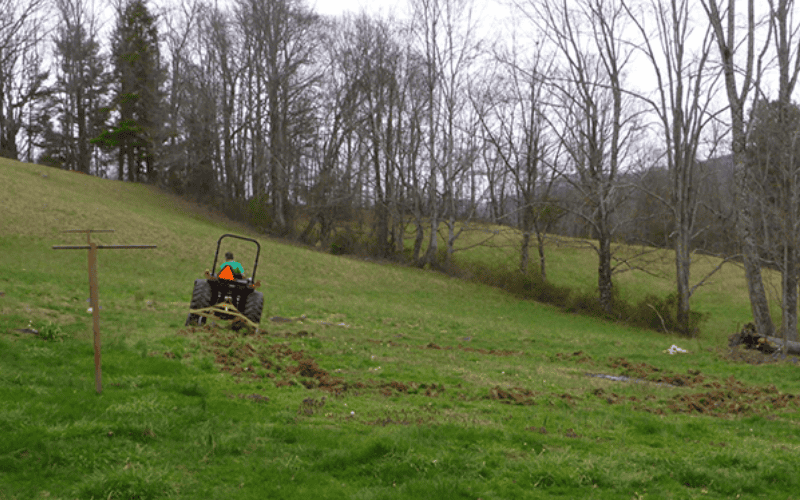
Nadeau mows a third to a half of a meadow each year, ideally using a flail mower, which chops vegetation into small pieces, helping foliage to resprout. The unmowed portion is left as a refuge for the animals that get evicted from their homes in the mowed area.
Stoner agrees with Mike to divide up the meadow and mow different sections at different times. And she validates my mowing trepidation.
“There’s no perfect time. Any time you mow, you will be disturbing the habitat of some creature. If you don’t mow, you will have invasive plants creeping in, and eventually you will have trees,” she said.
“Best thing is to think about what your goals are — what creatures do want to encourage in your meadow? Then set the time of mowing to protect and enhance the habitat for those creatures.”
Lights Out!
One of my favorite meadow benefits are the hundreds of fireflies that emerge in June. I am grateful for the lack of artificial light from neighbors (save for one house across the river with a persistent outside night light) so these creatures can shine brightly — and securely.
The organization DarkSky International relays the effect outdoor lights can have on fireflies: an almost 50% decrease in flashes per minute, which affects courtship behavior and mating success, according to two studies cited on its website, darksky.org.
There, you can also get the lowdown on the devastating effects even one outdoor light can have on birds, amphibians, insects and mammals. The organization provides educational materials that explain the issue, making it easier to bring up to neighbors and friends — which I will soon try with the house across the river.


We have large yard, covering of white clover, been allowing for years, looking really good. As much as possible pathways get mowed, it looks messy but many former tended flower beds are running wild on purpose, age and education have given me “permission ” to leave. Lots of natives or good non native pollinator plants. 2 great springs, shade and sun. As a Master Gardener I dig , divide and pot up for plant sales. A few beds partially open to new plants. Not using herbicides except some considered safer, poison ivy is rampant. We are seeing more native pollinators and swarms of wild honey bees being collected to share, lightning bugs are increasing again, butterflies, multiple solitary bees, the list is ongoing and of course frogs, toads and our birds. Only one neighbor, we are able to be a yard that is not highly trimmed and sprayed.
I don’t mow. I scythe. For 3 years I have been meadowing about 4 acres of an abandoned Vermont cornfield using hand tools. I do not seed. I wage war against Oriental Bittersweet, and Goldenrod principally. My aim is to expose the soil to the sun and see what happens. Using Plantnet I have identified about 300 or so natives of all kinds. The debris from scything is piled up nearby in dead hedges defining a path around the place which I DO mow with a gas powered mower.
I would really be interested in hearing from anyone else as nuts as I am. Perhaps Doug Tallamy’s staff could arrange that somehow.
What are your recommendations for mowing a meadow and tick control? I like to mow paths and that helps I think but ticks are insidious and I’ve had lyme disease and other tick borne illnesses too often. Deer visit frequently, less often in summer.
Two or three years ago, our lower lawn, almost an acre down by the river had sort of worn out after three decades of mowing. In quiet desperation, We just decided to let it go fallow. A year later, when it looked healthy and I knew there was a rain coming, i mowed it high. Amazing how it had come back to vitality. I spread pelletized lime on it, but no fertilizer. I have always mulched all the leaves in the fall with the mower, hoping to build more structure. Last week we went to the caterpillar movie. It totally blew our minds. We’re gonna let that lower lawn go fully to pasture. I’ll cut it when I feel like it, but I’m gonna resist the urge and see what pops up. Thanks.
Thank you for writing this article. I have been wondering about mowing, to mow or not and when is the best time. I keep the areas close to our and my neighbors homes mowed for aesthetics and fire prevention and because oir City requires it. But I only mow in my wilder areas in the back if I see weeds and weedy grasses taking over certain sections. I spend lots of time down there removing weeds though. It definitely takes some upkeep. I Wish I had a knowledgeable guide for this process. My unmowed areas team with life and pollinators in the warmer months. It is so wonderful to spend time there. One thing I have learned is I need to seed most of the grasses and plants I want. Some arrive in their own but not necessarily ones I want. My biggest challenge has been invasive exotic grasses. KR bluestem aka Old World Bluestem, Jointed Goat grass, Johnson grass, Rat Tail fescue and more. Oh and the horrible Maltastar Thistle. The truck is to ID plants as soon as you can. Apps help with this but they have a hard time with grasses. I have not had any Little Blustem come up from seed yet. Anyway thanks for what you are doing to educate people!
Managing a wild backyard habitat for biodiversity is a bit tricky but as the author says, once a year in early spring works best. I’ve gotten away from mowing altogether in favor of using a trimmer or brushcutter. Trouble with mowers is the blades and housing chop everything into tiny pieces so that any dormant life will be killed. A trimmer leaves stems in large pieces-makes a HUGE difference. For majority of homeowners who have converted their lawn to natives, a mower is unnecessary unless you have a large property. And cutting when dandelions are flowering?-ok but with a trimmer you can cut above the flowers and let one of nature’s great medicinal plants thrive and keep the pollinators happy.
It would have been helpful if you had included in your headline, the word “meadow”. I read several paragraphs before I realized that the article did not apply to me since I do not have a meadow, just a small yard.
I mow in late summer because it now gets filled with Japanese Stilt Grass 🤮 and I want to prevent seeds from forming.
I greatly appreciate all you’re doing for our environment. THANK YOU!
Yes! Fully agree. I don’t have a meadow and presumed this article pertained to a lawn. That used to the be topic with this question. I hate that I have any lawn but as we rent, I’m stuck with it. Luckily it’s small! However, I’m still left wondering if I should follow No Mow May, or anything of the like, as this article did not answer that.
Here’s a link to an article that Sheila Colla, Heather Holm and I had published a few years ago in Rewilding magazine on the subject of lawns and No Mow May. The title offers a clue to our thoughts (The Surprising Downside of #NoMowMay) but I hope you’ll find that the article also has some nuance to it :-). https://www.rewildingmag.com/no-mow-may-downside/