


Why Native Trees & Shrubs?
Native trees and shrubs are the foundation of thriving ecosystems. They feed pollinators, shelter and feed birds, and bring beauty to your yard through every season. Unlike non-native ornamentals, native species evolved alongside local wildlife and provide the food and habitat they depend on. Every native tree and shrub you plant helps restore biodiversity, right where you live.
It’s tempting to think first about adding flowers, but trees and shrubs often provide the most impact. Keystone species like oaks and willows can support hundreds of insects and birds. And when planted with “soft landings” underneath—areas of diverse native groundcover—they create layered habitat that supercharges your yard’s ability to support life.
Choosing & Planting the Right Way
Choosing the right tree and the right place to plant it is critical to long-term success. Get it wrong, and you could face root damage, expensive maintenance, sidewalk upheaval, or even early tree death. But get it right, and you’ll enjoy decades of shade, beauty, and benefits with very little upkeep.
Note: While this video provides excellent and broadly applicable guidance, it does mention a few nonnative species. We advocate planting only native species. For native trees with ornamental and ecological value in your ecoregion, check out our Keystone Plant Finder.
So where do you begin?
Start with four simple but essential questions:
1. What is the goal of the tree?
People often think of the aesthetics or cost of the plant first, but we recommend starting with a broader question: what is the goal of the tree?
For example, do you want the tree to provide shade, or are you trying to create a privacy row? Do you want it to be an ornamental feature near a house or a tree for children to climb in the backyard? Once you’ve determined the goal, you can start thinking about site conditions.
2. What are the soil and light conditions of the planting area?
Next, think about the planting site. Is the area soggy, dry, sunny, or shady? Does the soil drain well or stay compacted and clay-heavy? Some species prefer dry, rocky soils; others need rich, loamy conditions. You may be able to amend the soil—but you’ll have more success if you choose a species that thrives in what you’ve got.
Sunlight matters too: full sun means 6+ hours, partial sun means 3–6, and shade means less than that. Most trees need at least partial sun to thrive.
3. How big will the tree or shrub be at maturity?
It may look like a small stick now, but what about in 20 years? Will it fit comfortably as it spreads upward and outward? Consider nearby structures, sidewalks, overhead wires, and fences. Position your tree so that there is space all around with no obstacles to restrict canopy growth.
Don’t forget about the underground. A tree’s roots. A tree's roots can spread out even farther than its canopy, so it is essential to think about that space too. Is there a patio nearby that could be damaged by roots? Will the roots be constrained by the roots of neighboring trees?
Note: trees don’t break pipes, but large pipes could be a consideration. Be sure to look both up and down – you don’t want to cut down a healthy, mature tree simply because it has run out of space.
4. What are the secondary benefits of the tree?
You have narrowed down your list of trees to ones that will thrive in the area you’ve selected. Now you can think about specific species and secondary benefits. This is where it gets fun.
For example, if you live in a rural area, you might consider a tree that is deer-resistant. Maybe you’re looking for an evergreen tree so that you have year-round color or a tree that has brilliant red leaves in the fall. Perhaps you’d like a tree that flowers in the spring, or one that provides food for squirrels, hummingbirds, and other wildlife. Trees have a multitude of secondary benefits, so you’re sure to find the perfect fit.
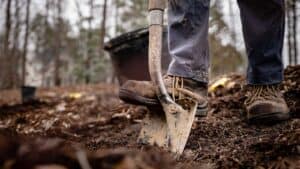 Because you’ve taken the time to consider the tree that suits your goal, you’ll have less work to do in the future. Selecting the tree that best fits your location will mean less care in the long run. You will also have given your tree the best chance at a long and healthy life.
More FAQs
Bonus: Plant Saplings
Planting trees when they are saplings is easier, requires less maintenance, and the trees typically grow more quickly.
1. Saplings are easy to plant. Because the root system is so young and dense, to plant, all you have to do is make a wedge in the ground using a small shovel or spade. There is no need to dig a large hole. Place the sapling in the hole with the roots facing down and loosely cover with dirt and a layer of wood chips. That's it!
2. Saplings are easier to maintain. Larger trees need a lot of attention during the first few years after planting. They require 10 to 20 gallons per week per inch of trunk diameter during the growing season. That is a lot of water! Smaller trees only really need water if there is a prolonged period of drought, and, even then, it should just be a small amount.
3. Saplings establish and grow more quickly. Younger trees have resilient root systems that can overcome the stress of being planted faster than larger trees can. This means they spend less time healing from damage and can put more energy into growing roots and shoots. In 5-10 years, a tree that is planted when it is younger will likely be taller and healthier than a larger tree planted at the same time.
This content is provided by Leaf & Limb.

Leaf & Limb is a Nature-first tree and land care company that cares for trees, flowers and soil. They work with Nature, deliver long‑term value, and have the proven, hands‑on expertise to get the work done right.
What is Nature-first tree and land care?
Our primary goals are to increase photosynthesis and transform dirt back to soil. Properly plant native trees. Help them attain a long, healthy life. Preserve existing trees. Get rid of lawns in exchange for native meadows planted from seed. Stop using fertilizers and harmful chemicals. Do everything we can to increase the abundance and diversity of life within the sub/urban landscape. This work takes time and there are no quick fixes.
By working with natural systems instead of against them, we help heal the Earth. As an added bonus, we also save time and money because we perform fewer tasks and use fewer products.
Project Pando
Project Pando is our non-profit where we connect people with trees to help heal the planet. We do this by operating a native seed hub that works with our community to collect seeds from native trees and shrubs. We then grow these seeds into saplings to benefit native restoration projects in our local ecosystem. Learn more about Project Pando.