

By Tim Snyder, Executive Director
Est Read Time: 5 min
Most of what we build wears down every year. Native habitat, on the other hand, grows in value, from one yard to one block to the rules a whole community follows.
I was in the Seward neighborhood of Minneapolis a few weeks ago. I met Jim and Susan, a Quaker couple who'd planted native species in their own front and back yard, and then kept going. They'd carried native plants across their block: into the hellstrips, the narrow public strips between sidewalk and curb that most people treat as a place to keep the grass from dying. Some of the plants were five or six feet tall.
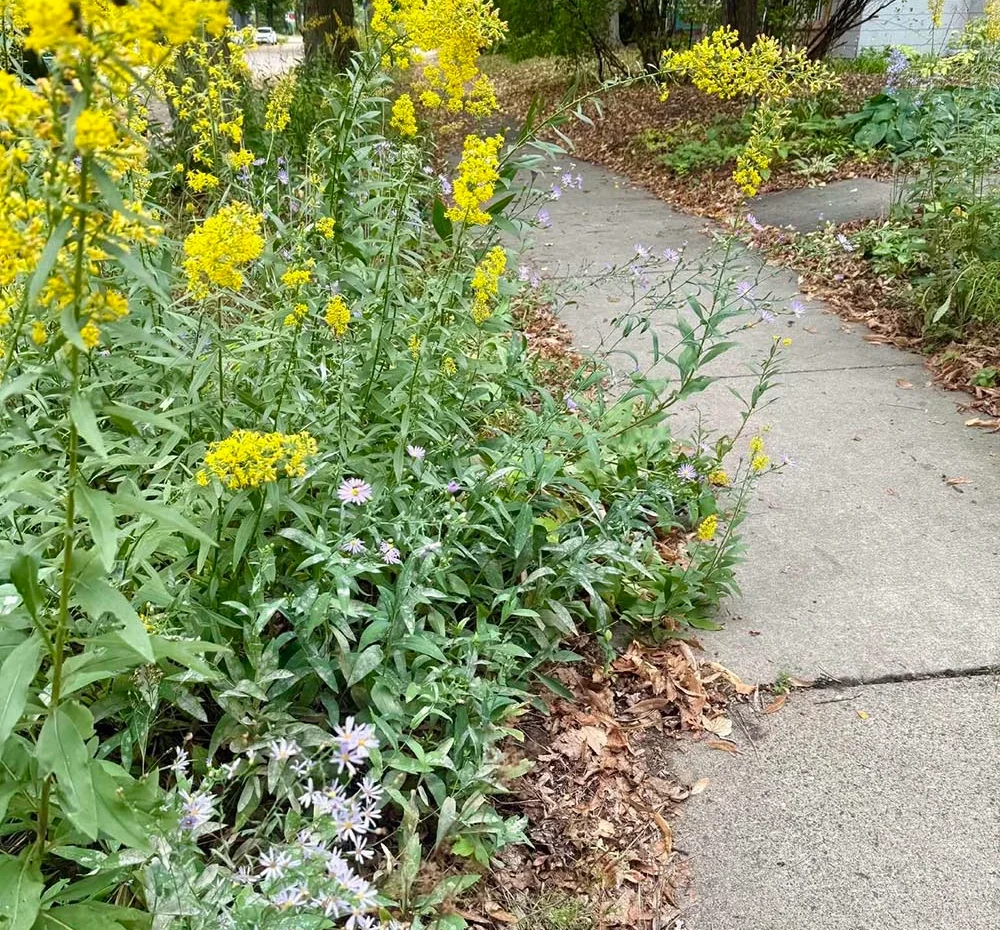
Photo from Jim Haefemeyer and Susan Hoch | Minneapolis, Minnesota
Walking the block, I noticed something else. A sidewalk slab cracked and waiting on repair. A pothole patched a shade darker than the street around it. A crosswalk worn down to a suggestion of paint.
That contrast stayed with me. I thought of something Doug Tallamy said at one of our team retreats. He'd been turning an idea over: most of what we build depreciates. Native habitat is one of the few things we build that appreciates.
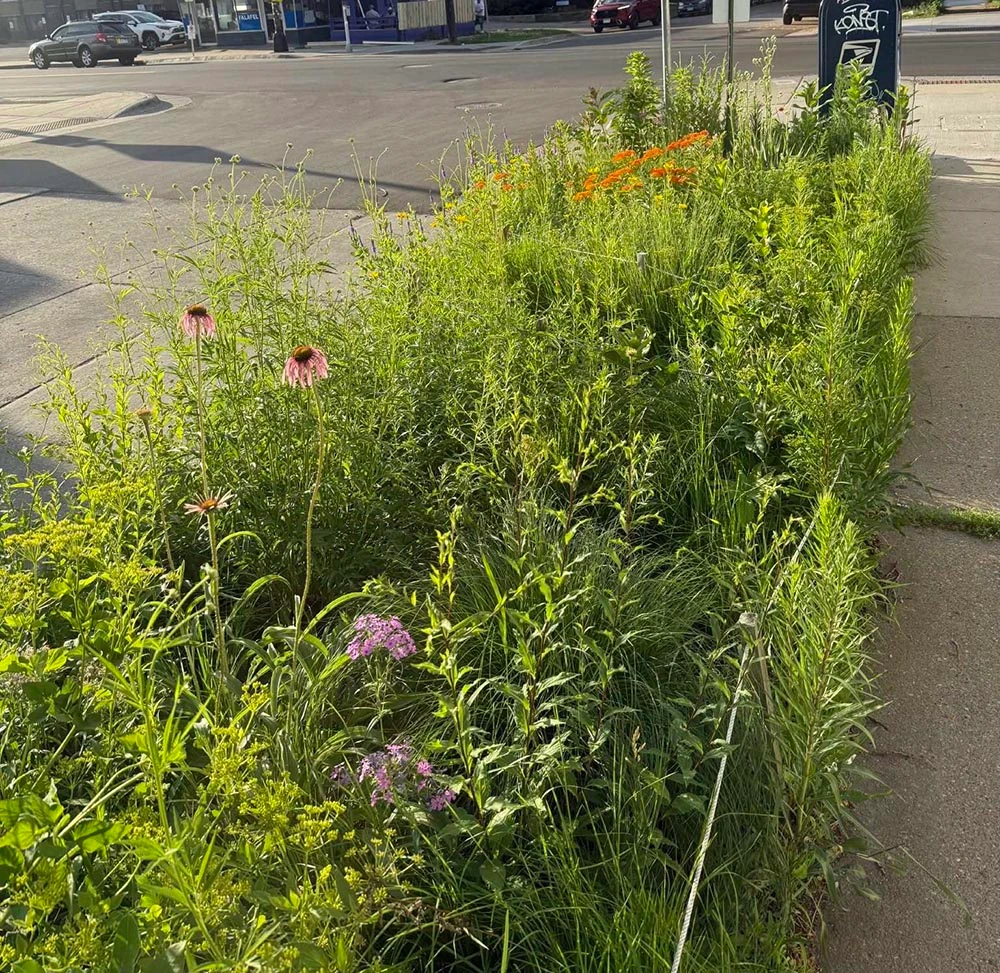
Photo from Jim Haefemeyer and Susan Hoch | Minneapolis, Minnesota
Most of what we build wears down
A lawn needs water, fertilizer, reseeding, mowing — every year, forever, and it never gets easier. A house needs a new roof eventually, new paint, a bathroom updated. A road cracks every winter as freeze and thaw work it apart. We spend money holding these things in place. At best, we slow the decline.
A native planting does the opposite; its roots go deeper each year. It needs less water over time, not more. It holds soil instead of losing it, and it supports more wildlife as it matures, which matters, because not every plant does that work. This is why we're promoting asters (genus Symphyotrichum) over mums: a mum is bred for color and thrown out after a season, feeding nothing. A native aster gives you the same fall color and comes back every year, feeding pollinators and birds through one of the last stretches of nectar before winter. That's not decoration. That's food that insects and birds depend on.
Even realtors are recommending native plants
So it's worth noting that the real estate industry is starting to say the same thing, in its own language. The National Association of Realtors now tells its own members to recommend native plants for curb appeal and resale value, pointing to the National Wildlife Federation's guidance to aim for 70% native in any yard.
When an organization built around real estate starts recommending native plants, that's a sign the culture is shifting, not just the science.
That's a small fact with a big implication, and it means the case for native planting isn't just an argument anymore. It's showing up in industry guidance written by people with no stake in ecology, only in what sells houses. When an organization built around real estate starts recommending native plants, that's a sign the culture is shifting, not just the science.
A hellstrip is an open invitation
Jim and Susan's own yard is theirs alone. Nobody on the block has to look at it, and most people don't unless they're invited. Their hellstrip is different by definition. It sits in public view, and everyone walking that block sees it whether they meant to look or not.
That's the mechanism, and it's why their choice to go beyond their own property line matters more than it might seem. A yard is a private decision. A hellstrip, or anything visible from the sidewalk, is a public argument made without saying a word. Neighbors don't need a pamphlet to be persuaded. They need to see something working, for a full season, on a street they already walk. Jim and Susan are demonstrating exactly that.
Neighbors don't need a pamphlet to be persuaded. They need to see something working, for a full season, on a street they already walk.
I've watched this play out across the Homegrown National Park community enough times to trust the pattern. One visible planting draws a question. The question leads to a conversation, sometimes over a fence, sometimes at a mailbox. The conversation leads to a second yard. HNP has a guide built around exactly this: how to talk with your neighbor about native planting
First the garden, then the rules
The public/private line gets more complicated when an HOA sets the rules for what's visible, and that obstacle is more common than it might seem. In the Arbor Day Foundation's 2025 Canopy Report, 14% of Americans cite HOA or local regulations as a reason they haven't planted a tree at all. HNP's guide to working with your HOA lays out a straightforward path: read your community's guidelines first, then start with one visible area rather than converting the whole yard at once. Give that area "cues to care" (clear borders, a defined path, signage, etc.), so it reads as planned rather than neglected. Talk to your HOA board about what you're doing and why, and where possible, join it. An insider voice for biodiversity carries further than an outside request.
But I don't want to frame the HOA only as an obstacle to route around, because that undersells what actually happens. Boards that see native planting done well sometimes become its advocates. Our HOA guide collects examples of exactly that shift: Broadlands, Virginia built native landscapes into its own identity as a community. Green Bay, Wisconsin and Austin, Texas rewrote their vegetation ordinances to formally support native planting instead of treating it as a violation waiting to happen. Evanston, Illinois removed milkweed from its noxious plant list once the board understood what it meant for monarchs. In each case, one modeled yard or garden came first. The policy came after, once the board had seen it work.
That sequence matters, because policy is a form of public support in its own right. A hellstrip is one household's public argument. An updated HOA guideline or city ordinance is the same argument made at the scale of a whole community, and it stays in place even after the household that first modeled it moves away. Jim and Susan's plantings are already doing the first kind of work. The second kind is getting that model written into the rules. That's the next step, and it's the one most likely to outlast any single yard.
The return keeps growing
That's the thread running through all of this. A lawn depreciates the moment you stop maintaining it. A hellstrip garden appreciates the longer it's left alone to do its work. And the same is true one level up: a single planting is worth something the day it goes in the ground, but a policy built around what that planting proved is worth something for as long as the policy stands. Jim and Susan's community hellstrips will still be growing next year. A rewritten ordinance modeled on it could still be standing in fifty.
That's the real return on a native planting. Not just what it does for one yard, but what it makes possible for the street, the board, and eventually the rule everyone else follows. Appreciation compounds.
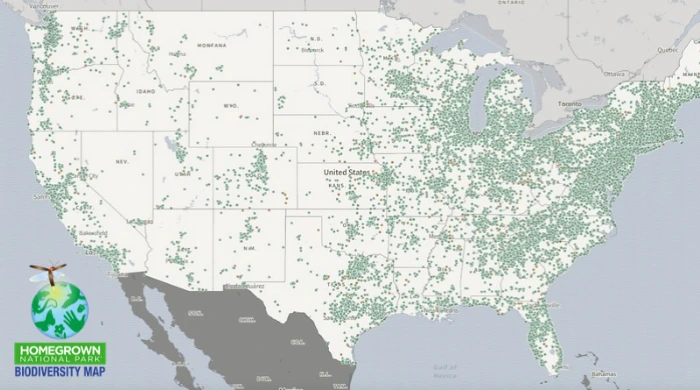
If you want in: you don't need a whole block, or even a whole yard. One native plant, one strip of ground, is enough to start setting a new expectation for your own street — and, in time, enough to change what your community writes down as the standard. Add your yard to the Biodiversity Map and see who's already appreciating nearby.