

Cover photo from Amanda Joy Photographics | Washington, DC
Est Read Time: 9 min
The Itty Bitty Mosquito Committee is making real progress on a goal we share: fewer mosquitoes, without harming bees, butterflies, and birds.
“You shouldn’t need bug spray to last three minutes on your own porch.” That’s how the Itty Bitty Mosquito Committee (Itty Bitty) puts it. They’re a neighbor-run group in Washington, DC, working block by block to bring mosquito populations down without fogging. It started with one listserv post in March. Today, more than 250 blocks have a neighbor leading the effort.
Their progress caught our attention because it matches what we’re seeing across the U.S. and Canada. The Mosquito Bucket Challenge has become one of our most popular campaigns, reaching more than 1.6 million people this year. The response tells us people don’t just want fewer mosquitoes. They want fewer mosquitoes without harming the wildlife around them, especially once they’ve planted native and invited nature into their yard.
“Many mosquito control methods kill beneficial insects that support birds and healthy ecosystems,” says Doug Tallamy, ecologist and co-founder of Homegrown National Park. “The Mosquito Bucket Challenge offers a practical way to reduce mosquito breeding while protecting the insects that wildlife depends on.”
The Challenge centers on a mosquito bucket with a Bti dunk. Bti (Bacillus thuringiensis israelensis) is a naturally occurring soil bacterium that kills mosquito larvae where they breed, without harming other wildlife. It’s part of a broader approach that also includes dumping standing water and planting native to attract mosquito predators like birds, bats, and dragonflies.
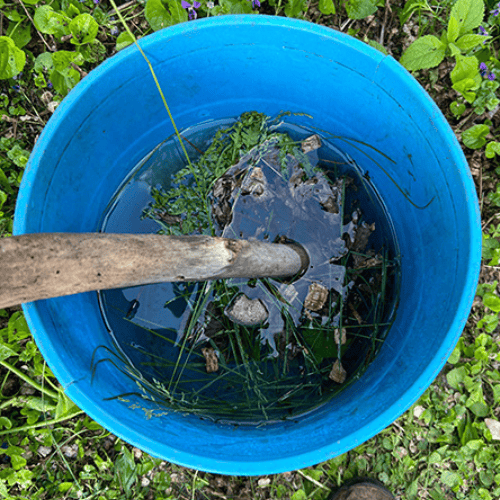
A Mosquito Bucket Challenge bucket. A Bti dunk keeps larvae from becoming adult mosquitoes.
Itty Bitty shows what that looks like when a whole neighborhood takes it on. We talked with their founder, Michelle Mingrone, about how it’s going.
How it started
Michelle tells it like this:
Mosquitoes in DC are brutal. I spent years fighting them in my own yard with almost no luck, and part of the problem was out of my hands. If my neighbor’s yard or the storm drain out front holds standing water, nothing I do in my yard will fix that. Then I read about a study in nearby University Park, Maryland, where neighbors teamed up to clear standing water and set out traps together. It clicked. Mosquitoes are a neighborhood problem, so you have to solve them as a neighborhood.
In March, I posted on our Capitol Hill listserv asking if anyone wanted to team up and try traps at a group discount. I figured a couple dozen people would answer. More than 100 replied in the first two hours. By the end of the week, 1,000 people had raised their hands. That’s when I knew this was bigger than my street.
We organize around five things any neighbor can do: 1) Toss standing water, 2) Treat what you can’t toss, 3) Trap mosquitoes, 4) Talk to your neighbors, and 5) Trade invasive plants for natives. Lots of neighbors already use buckets of doom, and we negotiated community discounts on traps that have been widely studied and proven in all kinds of environments. We don’t spray. We care deeply about the environment, but even setting that aside, spraying is expensive and doesn’t work very well. That’s reason enough.
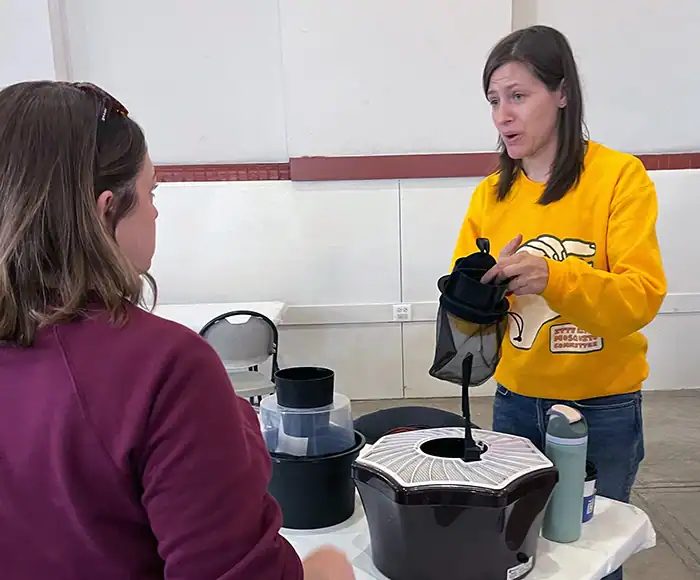
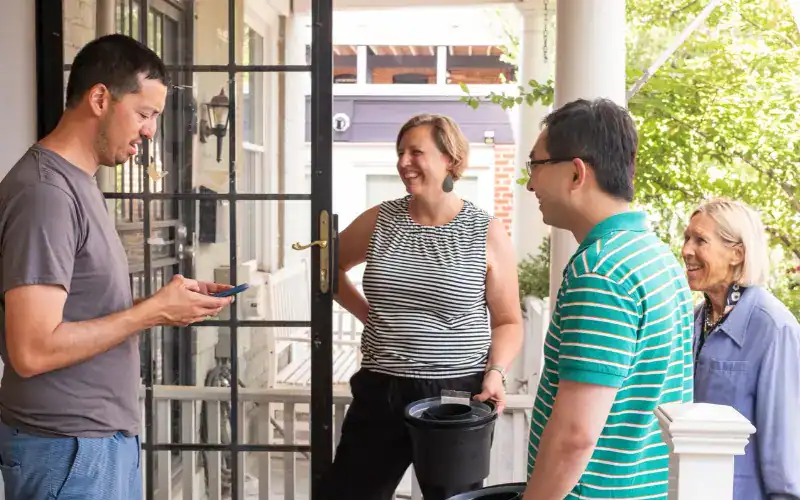
Michelle talks with neighbors about preventing mosquitoes next season and hears how this season went. Photo from Elizabeth Nelson
“Mosquitoes are a neighborhood problem, so you have to solve them as a neighborhood.”
- Michelle Mingrone, founder, Itty Bitty Mosquito Committee
Block by block
Mosquitoes don’t stop at a fence line. One household treating its own water doesn’t do much if the yard next door is untreated. Itty Bitty’s answer is the Block Captain: a neighbor who keeps their street informed, gets catch basins reported, and gets more neighbors setting traps.
The Mosquito Bucket Challenge starts in one yard, and it does more when neighbors join in. Itty Bitty’s Block Captains show what that looks like in practice.
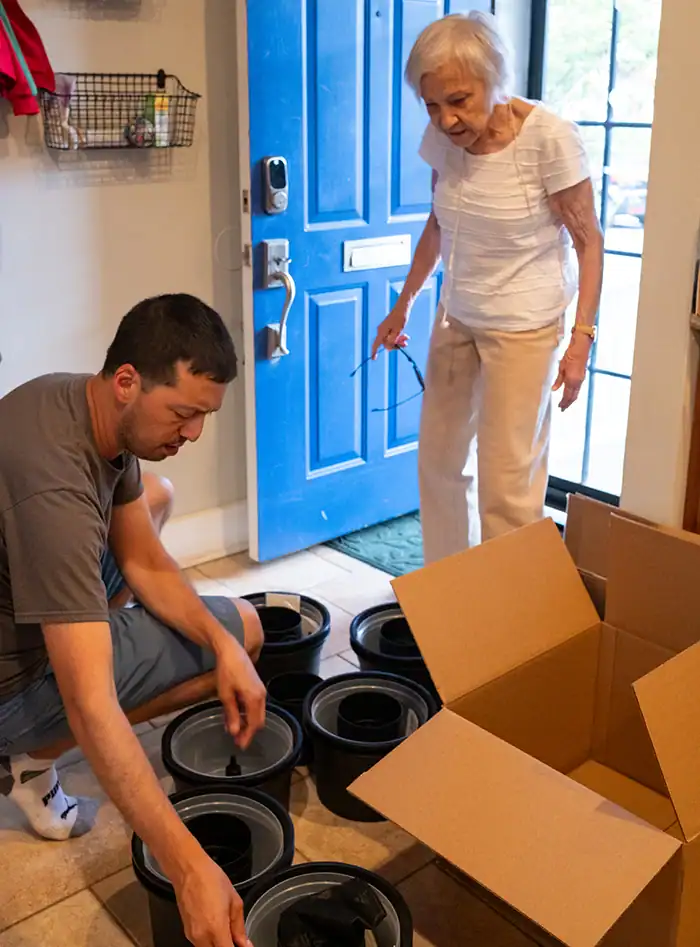
Block Captains organized group trap buys, sorting deliveries for their neighbors. Photo from Amanda Joy Photographics
Here’s how Michelle describes the role:
This first season, the only requirement for Block Captains was being a friendly, responsive neighbor who could connect your block with what we’re doing. We wrote a Block Captain handbook with suggested next steps, but past that, it was choose-your-own-adventure. People have different amounts of time, and blocks have different cultures. Some are tight-knit, some aren’t, and that’s okay.
Captains organized group trap buys, helped neighbors troubleshoot tricky spots, handed out flyers, and started block email lists. Some really ran with it. A few took over trap placement and maintenance for their entire block, and others customized flyers with their own stories and family photos. It was fun to watch neighbors make it their own.
There’s no single formula for a strong block. It depended on how much fun people had with it, how strong the block culture already was, and whether neighbors could team up and share the work. And on some blocks, Itty Bitty helped create that culture. Several people told us it gave them their first real reason to meet their neighbors.
Other blocks had a harder time. Some captains admitted they’d taken on more than their busy lives allowed, and not every neighbor was receptive to the effort. Keeping mosquitoes down was its own challenge. When mosquitoes didn’t drop right away or came back, it took some investigation and troubleshooting to figure out why. Travel made it harder, since traps and standing water went unchecked while people were away. Next season, we’ll draw on this year’s experiences and data to help captains navigate those challenges.
Making the effort visible
Itty Bitty records every trap placed and every treated catch basin in a shared portal. So far, that’s 543 homes and more than 1,300 logged traps. They’re also working with researchers to measure the impact these traps have on mosquito populations.
It’s the same idea behind our Biodiversity Map: turning scattered individual action into something people can see and count, so every yard becomes part of something larger. If you’ve planted native where you live, add your space to the Map.
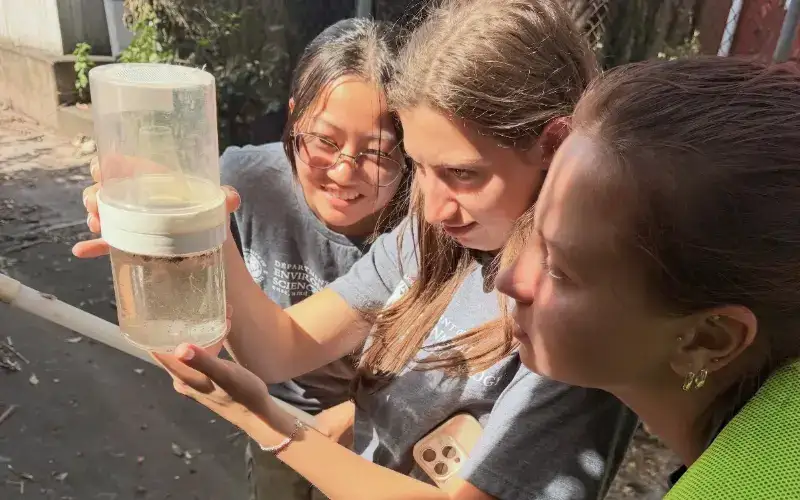
University of Maryland researchers check a trap’s catch as part of a study measuring mosquitoes on high- and low-participation blocks. Photo from Itty Bitty Mosquito Committee
Michelle on why the data matters:
I’m a data nerd by training, and I wanted to know whether all this effort was actually making a difference. I wasn’t alone. So many neighbors reached out offering their own analytics expertise and asking if we were collecting data.
Honestly, I didn’t expect much from our data collection efforts in our first season, when we were inventing everything as we went. It turned out to be more valuable than I could have imagined. Neighbors have told us the participation map encouraged them to join, because it showed this could actually work. It shows the city how invested residents are, and that we’re willing to do the work in our own yards. It’s also given us credibility when we reach out to other organizations and university researchers.
Showing where coverage is thin is part of the point. The gaps tell us where we need block captains and where to focus next season. They also give us something to compare against. At the end of this season, we teamed up with University of Maryland researchers to measure mosquitoes on blocks with high and low participation. Overlaying their counts on our participation map lets us see whether more participation means fewer mosquitoes. Neighbors already feel that it does. Now we can start backing that up with real numbers. Next season, we want neighbors to help collect those numbers through citizen science. That would also let us build evidence for tactics that haven’t been studied much at scale, like buckets of doom.
Data matters a lot to us, but never at the expense of our neighbors’ privacy. We share as much as we can without exposing anyone’s individual home.
Targeted, on purpose
Itty Bitty is deliberate about which mosquitoes they go after and why. Their traps and work to clear standing water focus on a small number of mostly nonnative, disease-carrying species that breed in containers around people’s homes. Broad spraying works the opposite way. It hits everything, including the predators that keep mosquitoes in check, but only kills the adult mosquitoes. The eggs and larvae in standing water survive, so populations can quickly bounce back.
That approach is close to home for us. It’s the same thinking behind removing invasive plants: deal with the specific problem, and protect the life around it.
“We’ll never get every mosquito, and we’re not trying to. We just want to spend time outside again!”
- Michelle Mingrone
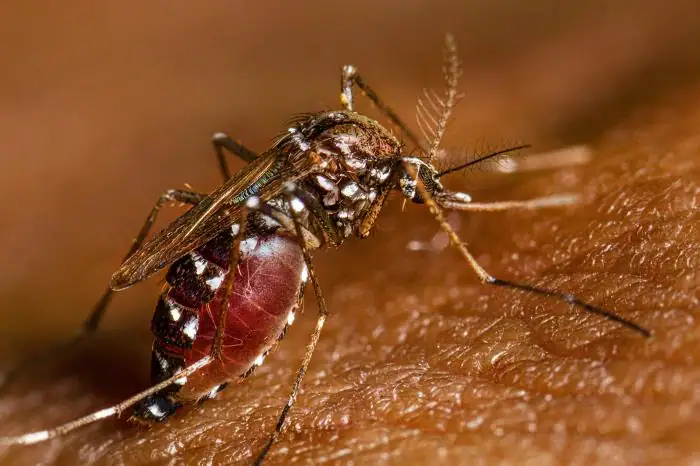
The invasive Asian tiger mosquito lays its eggs in containers around homes. Photo: Lauren Bishop/CDC, via the CDC Public Health Image Library
Michelle explains which mosquitoes they focus on:
The mosquitoes we go after carry disease, and two of the three are invasive. The Asian tiger mosquito and the yellow fever mosquito lay eggs in containers like buckets, gutters, and flowerpots. Culex thrives in clogged catch basins. All three breed right around our homes. We’ll never get every mosquito, and we’re not trying to. We just want to spend time outside again!
No single tactic beats mosquitoes, so our strategy is to combine as many proven ones as we can. Not everyone can do everything all the time, so we encourage neighbors to mix and match what works for them. Most people join because mosquitoes are driving them crazy. Many also care about pollinators and reducing pesticide use, and are looking for more options or a way to team up with their neighbors. Offering a range of tactics, from traps to trading invasive plants for natives, lets us reach both.
Increasing biodiversity is one of our tactics. At Kenilworth Aquatic Gardens in DC, you’re surrounded by standing water and barely get bitten. The ponds are full of fish, frogs, and dragonfly nymphs that eat mosquito larvae before they can grow up, so nobody needs to treat the water. A city block is different. Mosquitoes breed in gutters, trash cans, and catch basins, where those predators can’t reach them. Native plantings in our yards help bring back more of the wildlife that keeps mosquitoes in check.
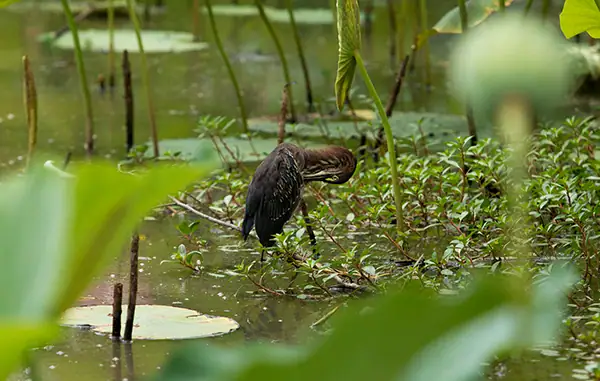
At Kenilworth Aquatic Gardens, a thriving pond ecosystem keeps mosquitoes in check. Photo: NPS/Kelsey Graczyk
If you’re worried about bats and birds, reducing mosquitoes has little to no effect on what they eat. They rely far more on moths and other insects, which depend on native plants. What does hurt them is spraying, which kills those insects too. And people spray when they’re fed up with mosquitoes. Fewer mosquitoes means less pressure to spray.
“With mosquitoes, the more of us, the less of them.”
- Michelle Mingrone
Biggest lessons learned
We asked Michelle what she’d tell other communities:
What I’d want a reader in another city to know before trying this on their block: Learn the biology. Once you understand how mosquitoes live and how each tool affects their life cycle, you can figure out why something is or isn’t working in your yard. Our problem spots in DC may not be yours, so start with your own block. You don’t need to be an expert. We’re all figuring this out together, and nobody’s perfect, me included. It’s hard work. Expect to troubleshoot, and never make anyone feel bad for falling behind.

Michelle identifies and counts mosquitoes from one of her traps. Next season, Itty Bitty hopes to make counting easier for neighbors to join. Photo from Itty Bitty Mosquito Committee
What I’d do again: hand over ownership. We gave block captains and neighbors the framework and trusted them to run with it, and it spread faster than anything we could have managed ourselves. I’d also keep bringing in experts to share what they know with the community.
What I’d do differently: real outreach. We grew almost entirely by word of mouth, and that only reaches so far. With mosquitoes, the more of us, the less of them. I also want to figure out how to lighten the load. Mosquitoes are on my mind all the time, but I don’t want them on everyone else’s. We’re all busy. And I’d work with the city more strategically. We talked with decision makers all summer, but there was no real plan behind it, and so much standing water sits in public spaces and utility vaults that residents can’t reach.
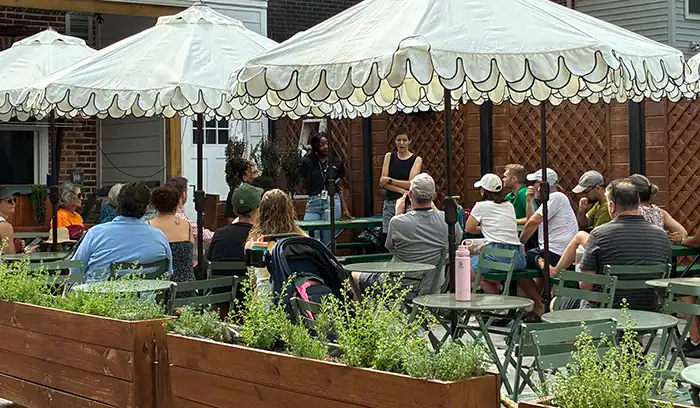
Neighbors met with DC Health to learn about the city’s role in mosquito prevention, then walked the neighborhood together to find and treat standing water. Photo from Angie Schmidt
What I’d love to learn: where the big levers are. Experiences varied a lot this year, and so many variables are at play: trap type and placement, construction sites, utility vaults, overgrown parks and tree boxes, native plantings. Which ones matter most, and by how much? Citizen science, university researchers, and groups like Homegrown National Park can help answer that, so neighbors anywhere can solve problems on their own blocks.
Two efforts, one goal
Itty Bitty is building a neighborhood network in DC. We’re building a movement of people across the U.S. and Canada connecting what they do at home to science-based habitat restoration. Both efforts share a goal: fewer mosquitoes where we spend time outside, without harming the wildlife around us.
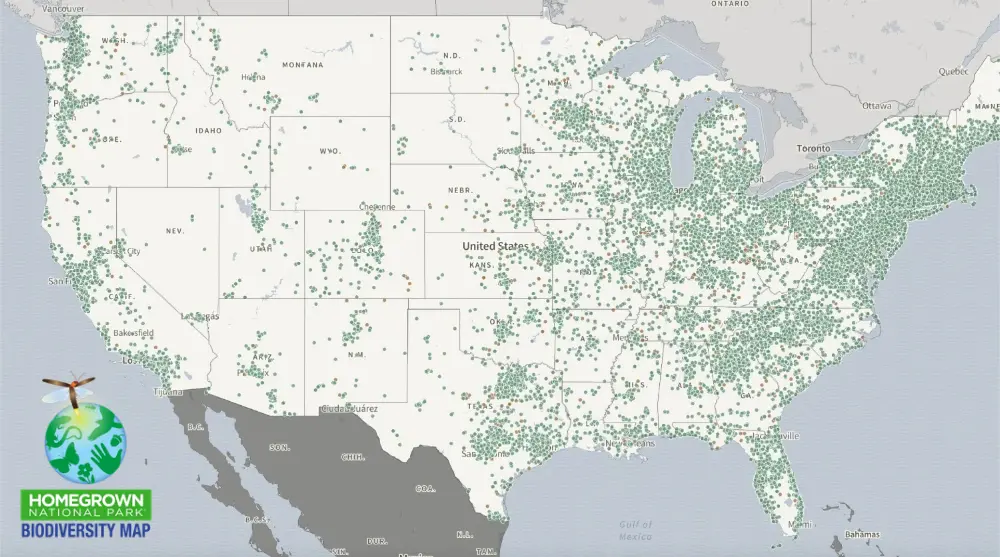
The HNP Biodiversity Map connects native plantings across the U.S. and Canada.
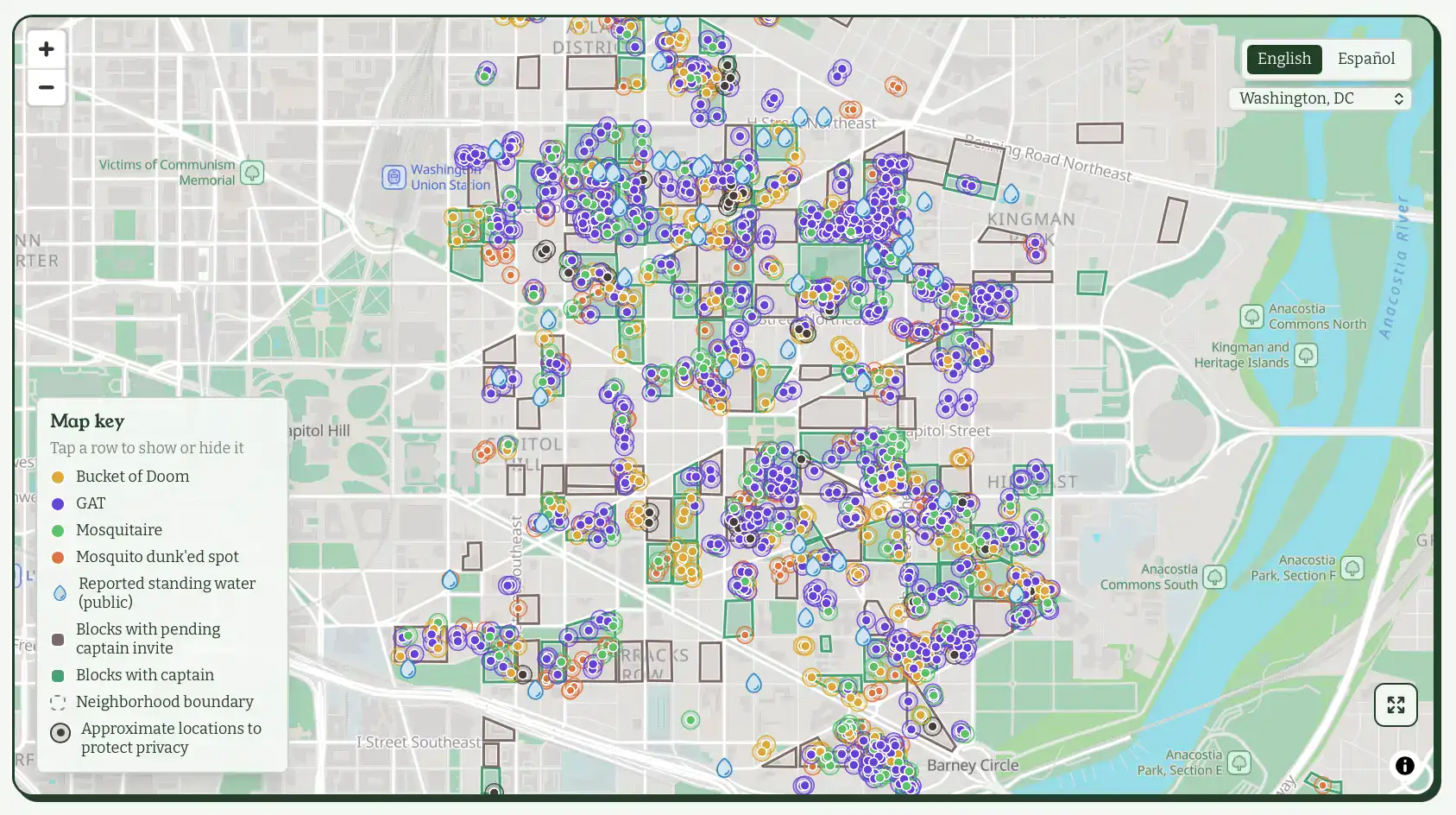
Itty Bitty’s impact map tracks mosquito control block by block in DC.
We’re learning from each other’s work, and Michelle’s question about the big levers is one we’re asking too. Which actions do the most good, and how do we help more people take them? Some answers will come from researchers. Many will come from neighbors trying things where they live and sharing what they learn. Start with one bucket, a few native plants, or a conversation with the neighbor next door, and you’re part of finding out.
Ready to start where you live? Join the Mosquito Bucket Challenge →
Want to see what’s happening in DC? Visit the Itty Bitty Mosquito Committee →